For years, one of the simplest assumptions in small-scale importing was this:
Keep an imported shipment under $800 and it can usually enter the United States duty-free under the de minimis exemption.
For online sellers, that made small international orders relatively easy to test.
A reseller could order 20 units from an overseas supplier, receive them through an express carrier, evaluate whether the product sold well, and place a larger order later.
That assumption is now outdated.
Duty-free de minimis treatment for most commercial imports valued at $800 or less was suspended for goods from all countries beginning August 29, 2025. In June 2026, U.S. Customs and Border Protection formally implemented an indefinite regulatory suspension for non-postal shipments, while a separate rule addressed international mail.
For ecommerce businesses, the practical result is straightforward:
A small shipment is no longer automatically a duty-free shipment simply because its value is below $800.
That changes how sellers should calculate product costs, negotiate with overseas suppliers, test new products, compare domestic and foreign sourcing, and set retail prices.
What Was the De Minimis Exemption?
The de minimis rule under Section 321 of U.S. customs law historically allowed qualifying shipments valued at $800 or less to enter the United States without the normal duties and formal customs procedures that might apply to larger commercial imports.
That was especially useful for:
- small ecommerce businesses
- marketplace resellers
- direct-to-consumer brands
- product samples
- small wholesale orders
- replacement parts
- test inventory
- low-volume international sourcing
The shipment value mattered enormously.
A qualifying $650 shipment could often enter differently from a much larger commercial import.
That distinction has largely disappeared for commercial merchandise.
CBP currently states that imported goods valued at or below $800 from all countries are no longer generally eligible for duty-free de minimis treatment and can be subject to applicable duties, taxes, and fees.
The $800 Number Has Not Become a New Tariff Rate
This point is important.
The end of de minimis does not mean every package under $800 suddenly pays the same tax.
There is no universal:
“Under-$800 import tax.”
The amount owed can depend on factors including:
- the product
- its Harmonized Tariff Schedule classification
- country of origin
- customs value
- applicable tariff programs
- additional duties
- trade remedies
- entry type
- transportation method
- exemptions that may apply
Two products that both cost $500 can therefore have very different import costs.
A ceramic kitchen item and an electronic component may fall under entirely different tariff classifications and duty structures.
That is why sellers should stop treating customs as a simple percentage added to every international purchase.
What Happens to Low-Value Non-Postal Shipments Now?
For shipments entering outside the international postal network—for example, many courier, express, air-cargo, and freight shipments—CBP says the merchandise must use an appropriate customs entry type through the Automated Commercial Environment and be filed by a party qualified to make entry. Applicable duties, taxes, fees, and other charges can apply.
The June 2026 CBP regulation made the suspension indefinite for these shipments.
That does not mean every small reseller needs to personally learn the entire ACE customs system.
In many cases, a:
- customs broker
- express carrier
- freight forwarder
- logistics provider
handles much of the entry process.
But the seller still needs to understand the cost.
A shipment that once arrived with little customs expense may now generate additional charges before the inventory becomes available for sale.
Small Shipments Can Still Use Informal Customs Procedures
The end of de minimis does not automatically mean every $300 shipment requires the same process as a $100,000 commercial import.
CBP’s June rule notes that merchandise that previously qualified for de minimis can instead use an appropriate customs entry type, including existing informal entry procedures for qualifying merchandise valued at $2,500 or less.
That threshold should not be interpreted as a guarantee that every product under $2,500 qualifies for informal entry.
Certain merchandise may require different treatment because of the product itself or another federal requirement.
But for many ordinary commercial products, informal entry can make small imports considerably simpler than a traditional large commercial shipment.
International Mail Is Changing Too
International postal shipments have their own procedures.
CBP also suspended the de minimis exemption for merchandise arriving through the international postal network and created a new postal informal-entry framework.
One particularly timely change is coming soon.
CBP plans to begin testing a new electronic informal entry process for international mail on September 22, 2026. The test introduces a new electronic Entry Type 13 process for qualifying mail shipments.
Small businesses do not necessarily need to file these entries themselves.
Carriers, brokers, postal operators, and other qualified parties may handle the operational side.
But sellers should expect customs processing of low-value mail to become increasingly structured and data-driven rather than assuming that a small package will simply pass through because of its low value.
The Biggest Change for Sellers Is Landed Cost
For a reseller, the purchase price is not the true cost of imported inventory.
The number that matters is landed cost.
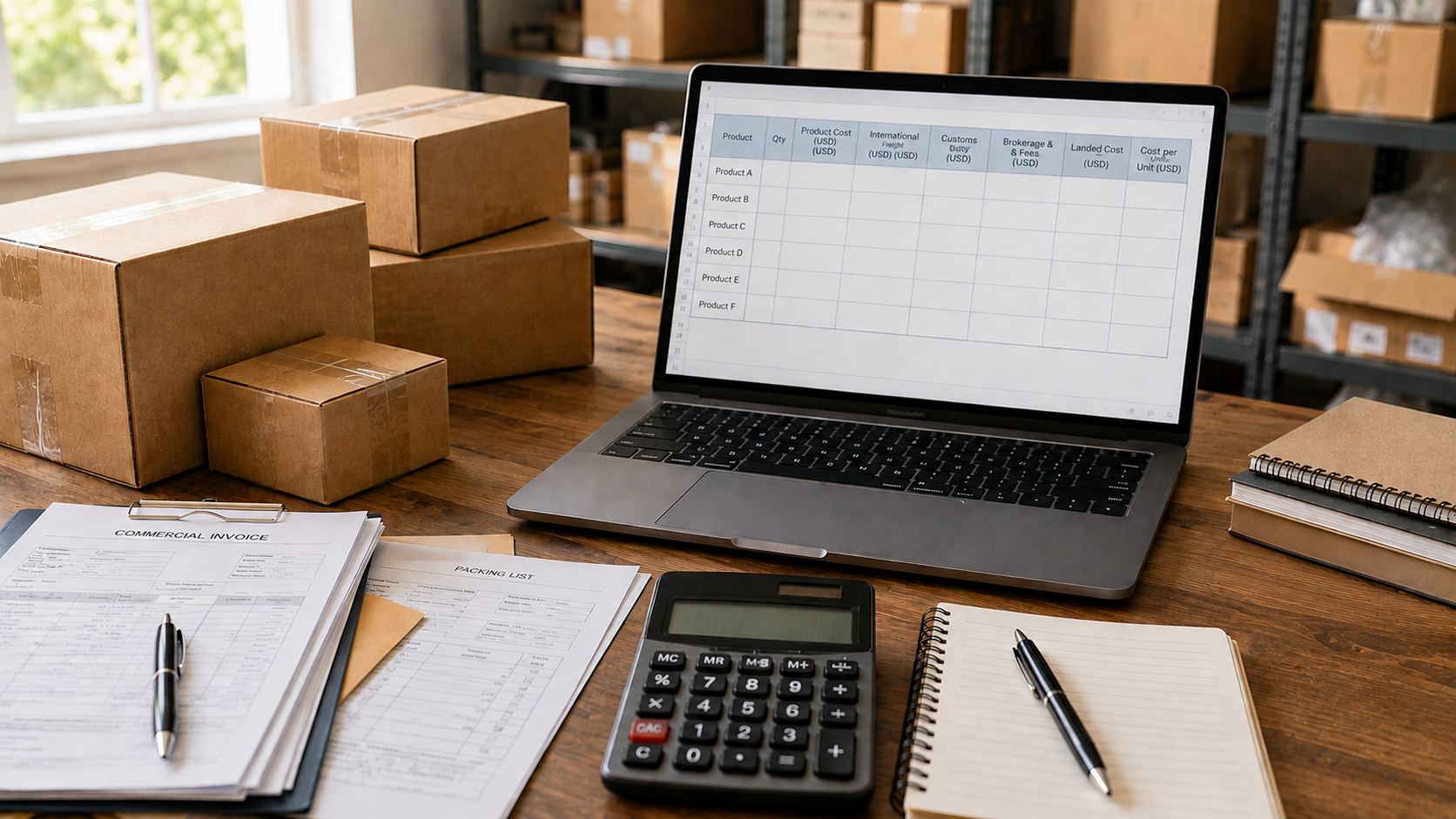
A useful simplified formula is:
Landed Cost = Product Cost + International Freight + Duties + Customs/Brokerage Fees + Insurance + Domestic Transportation + Other Import Costs
Then:
Landed Cost Per Unit = Total Landed Cost ÷ Sellable Units
This is the number that should eventually enter your profitability calculation.
A Simple Example
Suppose you find a supplier overseas selling a product for:
$8 per unit
You order:
100 units
Product cost:
$800
At first glance, your cost per item appears to be $8.
But suppose the shipment also produces the following costs:
International freight: $180
Assumed duties and tariffs for this hypothetical example: $120
Brokerage/customs charges: $55
Domestic delivery from the import facility: $45
Your actual inventory cost becomes:
$800 + $180 + $120 + $55 + $45 = $1,200
Your landed cost is therefore:
$1,200 ÷ 100 = $12 per unit
The product did not really cost you $8.
It cost approximately $12 per sellable unit before marketplace fees, customer shipping, advertising, returns, packaging, or other business expenses.
That difference can completely change whether the product is worth selling.
The duty amount in this example is hypothetical. Actual rates depend on the merchandise, origin, current tariff schedule, and other factors.
Find the HTS Classification Before You Place a Large Order
Imported merchandise is classified under the Harmonized Tariff Schedule of the United States, commonly called the HTS.
That classification helps determine the normal duty treatment and can also interact with additional tariff provisions.
The U.S. International Trade Commission publishes the current HTS and updates it throughout the year.
Those updates are happening frequently in 2026.
For perspective, HTS Revision 17 was released on August 24, 2026, only four days before this article was fact-checked.
That illustrates why copying a duty percentage from an old blog post, supplier message, or spreadsheet can be dangerous.
Use the current tariff schedule.
How to Research an HTS Code
The USITC’s HTS search system allows users to search by product description or tariff number.
Start with the product itself.
For example:
stainless steel water bottle
is more useful than:
home product
Product details may matter, including:
- material
- primary function
- construction
- composition
- size
- intended use
- whether the product contains other components
Small differences can result in different classifications.
For expensive or recurring imports, relying solely on your own guess is risky.
A customs broker or trade professional can help when classification is unclear.
CBP also maintains a searchable database of customs rulings that can provide useful examples of how similar merchandise has previously been classified.
Do Not Let the Supplier Choose Your Economics for You
An overseas supplier may tell you:
Duty is only 5%.
Treat that as a starting point—not a guarantee.
The supplier may not know:
- your exact U.S. tariff classification
- the current U.S. tariff revision
- additional duties
- your import method
- applicable customs fees
- special trade rules
- whether their claimed country of origin is legally correct
The supplier is selling the merchandise.
The importer ultimately needs the correct customs treatment.
Before placing a meaningful order, independently verify the expected import cost.
Country of Origin Matters
Country of origin is not always the same thing as the country the package ships from.
Suppose a product is manufactured in Country A, sent to a warehouse in Country B, and then shipped to the United States.
Country B does not automatically become the product’s customs origin simply because the parcel left from there.
Origin rules can be considerably more complicated, particularly when components and manufacturing processes involve multiple countries.
This matters because tariff treatment may vary by origin.
For ordinary small sellers, the important principle is:
Do not assume “ships from” means “made in.”
Ask the supplier for the actual manufacturing origin of the merchandise.
DDP vs. DAP Suddenly Matters More
When buying internationally, sellers often encounter shipping terms such as DDP and DAP.
Understanding them becomes more important when duties are no longer routinely avoided through de minimis treatment.
DDP — Delivered Duty Paid
In a typical DDP arrangement, the seller arranges transportation and assumes responsibility for specified import formalities and duties through delivery under the agreed Incoterm structure.
A buyer might receive a quote like:
100 units delivered to your warehouse: $1,450 DDP
This can simplify budgeting because more of the import cost is included in one number.
But sellers should still understand how the transaction is structured.
Ask:
- Who is the importer of record?
- Are all duties included?
- Are brokerage charges included?
- Are there destination fees?
- Who pays if customs reassesses the shipment?
DAP — Delivered at Place
Under a DAP arrangement, the seller transports the goods to the agreed destination, but the buyer typically remains responsible for import clearance, duties, and taxes.
A supplier quote may appear cheaper:
$1,050 DAP
But another $300–$500 in import-related costs could appear afterward.
Comparing a DDP quote with a DAP quote using only their headline prices can therefore produce a bad sourcing decision.
Compare total landed cost instead.
Create an Import Cost Worksheet Before Ordering
For every internationally sourced product, estimate:
| Cost | Estimate |
|---|---|
| Product purchase | $ |
| International shipping | $ |
| Customs duties | $ |
| Additional tariffs | $ |
| Brokerage / entry fees | $ |
| Insurance | $ |
| Domestic delivery | $ |
| Inspection or storage charges | $ |
| Total landed cost | $ |
| Units received | |
| Landed cost per unit | $ |
Then continue the calculation:
| Sales Economics | Amount |
|---|---|
| Expected selling price | $ |
| Landed product cost | $ |
| Marketplace/payment fees | $ |
| Fulfillment/shipping | $ |
| Packaging | $ |
| Advertising | $ |
| Return allowance | $ |
| Estimated profit | $ |
This prevents one of the most common sourcing mistakes:
evaluating profitability using the supplier’s unit price rather than the actual landed cost.
Small Test Orders Need to Be Reconsidered
The de minimis system made tiny test orders unusually attractive.
Suppose you wanted to experiment with a new product.
Instead of importing 1,000 units, you might first order:
25 units × $20 = $500
If those goods qualified for the old de minimis treatment, customs friction could be minimal.
Now the small shipment can still incur:
- duties
- customs processing
- brokerage
- carrier advancement fees
- documentation costs
Those fixed expenses can be especially painful on small orders.
For example:
A $50 brokerage cost on a $500 shipment equals 10% of the merchandise value.
The same $50 cost on a $5,000 shipment equals only 1%.
That does not mean sellers should stop testing products.
It means the optimal test quantity may change.
Consolidating Orders Can Reduce Per-Unit Costs
Imagine importing two small orders separately.
Shipment A
Products: $600
Shipping/customs-related fixed costs: $120
Shipment B
Products: $700
Shipping/customs-related fixed costs: $130
Combined overhead:
$250
Now imagine the supplier can consolidate the merchandise safely into one properly declared shipment.
The total product value remains:
$1,300
But perhaps combined freight and processing costs are:
$185
Consolidation saved:
$65
The exact result varies significantly by carrier, shipment size, weight, entry method, and product.
But the principle is useful:
Once low-value shipments lose their special duty advantage, fragmented purchasing becomes less attractive.
Do Not Ask Suppliers to Undervalue Shipments
Some sellers may be tempted to respond to higher import costs by asking a supplier to declare a lower value.
Do not do this.
CBP has explicitly highlighted undervaluation and false import information as customs-enforcement concerns. A June 3, 2026 executive order on customs enforcement specifically identified undervaluing imports and withholding importer or merchandise information as examples of noncompliance.
Your invoice and customs declaration should accurately represent the transaction.
Saving a small amount of duty is not worth creating a customs compliance problem.
Domestic Suppliers May Become More Competitive
The disappearance of easy duty-free low-value imports changes sourcing comparisons.
Consider:
Overseas Supplier
Unit price: $6
Landed cost after freight and import expenses: $9.25
Lead time: 30 days
Minimum order: 500 units
Domestic Supplier
Unit price: $10
Domestic delivery cost: $0.50 per unit
Landed cost:
$10.50
At first glance, the overseas source is still cheaper.
But the difference is now:
$1.25 per unit
rather than:
$4 per unit
Then consider:
- shorter domestic lead time
- smaller minimum orders
- easier returns
- lower inventory commitment
- fewer customs uncertainties
- faster replenishment
The overseas product may still be the better choice.
But the answer is no longer obvious from the supplier’s factory price.
Recheck Existing Products Imported Before the Change
Products already in your catalog deserve attention too.
Suppose a product was originally sourced when its landed cost was:
$11
Your current selling price is:
$24.99
After new import costs, replacement inventory might cost:
$14
Your old inventory remains profitable.
But the next purchase order may not be.
This creates a dangerous situation because historical accounting can make a product appear more profitable than future inventory actually will be.
Before reordering internationally sourced products, calculate the replacement landed cost.
Do not rely only on what the last shipment cost.
Watch Your Reorder Point
Customs processing can also affect inventory timing.
A shipment delayed several days because of documentation, entry, classification, or duty issues can create stockouts.
If your previous reorder formula assumed:
25-day supplier lead time
but importing now regularly takes:
32 days
your reorder point may need adjustment.
Suppose a product sells:
8 units per day
An extra seven days of lead time represents:
56 units
of additional expected demand.
That difference can matter significantly during busy sales periods.
Build a Customs Buffer Into New Product Research
When evaluating an unfamiliar international product, consider adding a temporary cost buffer until you have completed an actual import.
For example, your spreadsheet might contain:
Supplier price
Expected duty
Expected freight
Brokerage estimate
5% import-cost contingency
Once you complete several shipments and understand the real costs, you can replace the contingency with actual historical numbers.
That is safer than assuming every charge will match the supplier’s first estimate.
Keep These Import Documents
For resale inventory, save:
- commercial invoices
- purchase orders
- supplier invoices
- packing lists
- freight invoices
- customs entry documentation
- brokerage invoices
- duty statements
- country-of-origin information
- product classification records
- payment records
- insurance documents
Also connect those costs to the relevant inventory purchase in your accounting system.
Otherwise, a $400 customs bill may end up recorded as a random operating expense rather than being associated with the products that actually caused it.
The Policy Is Not Just a Short-Term Experiment
Sellers should not build a business model around the expectation that the old de minimis treatment will simply return.
CBP’s June 24, 2026 rule created an indefinite regulatory suspension for non-postal low-value merchandise. The rule also notes that Congress has enacted a statutory termination of the relevant de minimis authority beginning July 1, 2027.
A federal trade court also upheld the government’s authority to terminate the low-value exemption in an August 13, 2026 decision.
For sourcing decisions, it is therefore more prudent to model imports under the current system rather than assume the previous $800 exemption will return.
A Practical Checklist for Online Sellers
Before placing your next overseas inventory order:
- Identify the product’s likely HTS classification.
- Confirm the actual country of origin.
- Check the current U.S. tariff schedule.
- Estimate ordinary duties and any additional duties that may apply.
- Ask whether the shipping quote is DDP, DAP, or another Incoterm.
- Identify who will act as importer of record.
- Ask your carrier or broker about entry and brokerage fees.
- Calculate total landed cost rather than supplier cost.
- Divide that cost across actual sellable units.
- Recalculate your expected margin.
- Compare the result with domestic sourcing alternatives.
- Save all customs and purchase documentation.
- Recalculate replacement cost before reordering an older product.
- Never ask a supplier to understate the shipment value.
Final Takeaway
The disappearance of duty-free de minimis treatment does not mean international sourcing is no longer worthwhile.
Overseas manufacturers can still provide excellent products, prices, capabilities, and margins.
What changed is the math.
The old model could sometimes look like:
Supplier price + shipping = inventory cost
The more realistic model now is:
Supplier price + freight + duties + tariffs + customs processing + brokerage + domestic transportation + other import costs = landed inventory cost
That landed cost—not the supplier’s unit price—is the number that should drive your sourcing decision.
For online sellers, the most important response to the 2026 import environment is therefore not panic.
It is better accounting before the purchase.
A product that still produces strong margins after every import cost is included may be a good sourcing opportunity.
A product that only looks profitable when customs costs are ignored probably never was.
Sources
U.S. Customs and Border Protection — Duty Waiver / De Minimis Policy
CBP states that duty-free de minimis treatment for most imports valued at $800 or less from all countries was suspended effective August 29, 2025.
CBP de minimis guidance
U.S. Customs and Border Protection — Suspension of Duty-Free De Minimis Treatment
Official CBP guidance covering non-postal and postal shipments.
Federal Register — Indefinite Suspension of the De Minimis Exemption
CBP’s June 24, 2026 regulatory suspension for merchandise arriving through modes other than the international postal network.
Federal Register — De Minimis Suspension for Mail Shipments
CBP’s separate 2026 rule governing international postal imports.
Federal Register — New Electronic Informal Entry Process for Mail
The Entry Type 13 test begins September 22, 2026.
U.S. International Trade Commission — Harmonized Tariff Schedule
The current HTS was most recently updated with Revision 17 on August 24, 2026.
USITC Harmonized Tariff information
Recent Comments