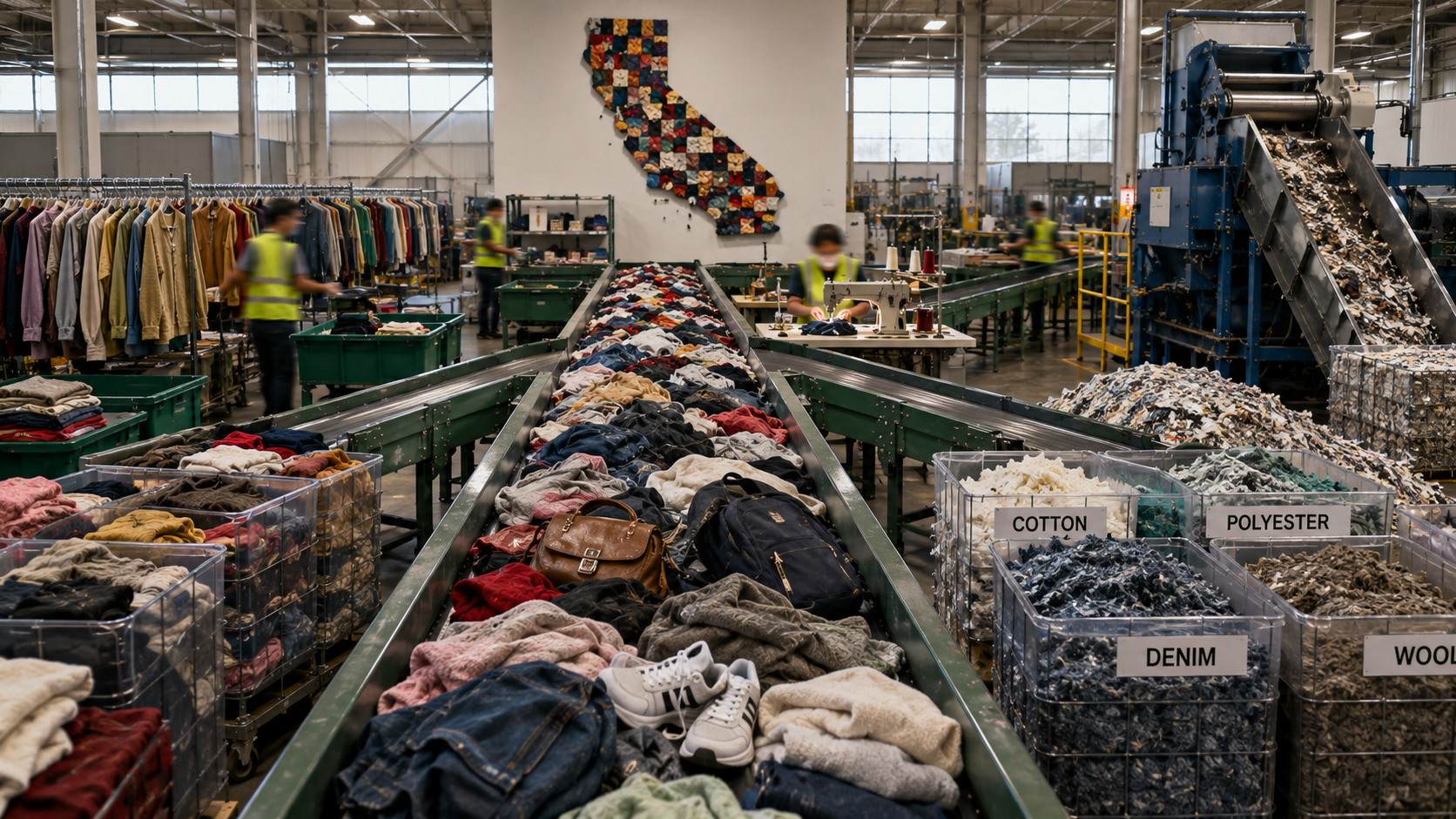
Selling a shirt online to a customer in California may now create a responsibility that has nothing to do with sales tax, shipping, product safety, or marketplace fees.
California’s Responsible Textile Recovery Act of 2024, commonly known as SB 707, is creating a statewide extended producer responsibility program for apparel and household textiles.
Instead of leaving cities and consumers responsible for dealing with unwanted clothing, shoes, linens, and similar textile products, the law shifts significant responsibility toward the businesses putting those products into the California market.
That matters to more than large fashion companies.
Depending on how a product is branded, imported, and sold, the responsible “producer” can potentially be a manufacturer, brand owner, importer, distributor, wholesaler, or retailer. The law also explicitly addresses online marketplaces and products sold into California from outside the state.
One major deadline has already passed.
CalRecycle approved Landbell USA as the state’s producer responsibility organization, or PRO, on February 27, 2026, and says producers of covered products were required to join it by July 1, 2026.
At the same time, California is still developing many of the regulations that will determine how the program operates in practice. CalRecycle held an August 13, 2026 workshop specifically addressing definitions and online marketplaces, and another workshop is scheduled for September 29, 2026 covering producer identification, exemptions, collection, repair, reuse, and end markets.
For ecommerce businesses selling clothing or textile goods into California, now is a good time to determine where they fit.
What Is Textile EPR?
EPR stands for extended producer responsibility.
The basic idea is that the business placing a product into the market helps fund and manage what happens to that product at the end of its useful life.
Under SB 707, California is establishing a system intended to increase:
- textile collection
- repair
- reuse
- resale
- recycling
while reducing the amount of clothing and household textiles entering landfills.
The statewide system will eventually include collection locations, sorting operations, repair infrastructure, recycling, consumer education, and other programs.
Participating producers will fund the system through the approved PRO rather than every clothing company creating its own statewide recycling network.
Why Online Sellers Outside California Should Pay Attention
You do not need a warehouse, office, or store in California for the law to potentially matter.
SB 707 states that its purpose includes making producers responsible regardless of whether they are domiciled in California when they sell, offer for sale, or distribute covered products into the state.
Even more importantly for ecommerce businesses, the law says a sale is considered to occur in California when the covered product is delivered to the consumer in California.
Consider an apparel business located in Tennessee.
It operates exclusively online.
A customer in Los Angeles orders a jacket.
The seller ships the jacket directly to that customer’s California address.
For purposes of SB 707, the fact that the seller has no physical California storefront does not automatically place the transaction outside the law.
For ecommerce operators, the destination of the product matters.
What Products Are Covered?
SB 707 divides covered products primarily into apparel and textile articles.
The apparel definition is broader than many sellers might expect.
Covered apparel includes items such as:
| Apparel | Household Textile Articles |
|---|---|
| Shirts | Blankets |
| Pants | Curtains |
| Skirts | Fabric window coverings |
| Dresses | Towels |
| Undergarments | Tapestries |
| Jackets | Bedding |
| Coats | Tablecloths |
| Athletic wear | Napkins |
| Swimwear | Linens |
| School uniforms | Pillows |
| Workwear | |
| Footwear | |
| Handbags | |
| Backpacks | |
| Scarves | |
| Knitted and woven accessories |
The statute contains the complete definitions and should be checked for products that fall near the boundaries.
The inclusion of footwear, handbags, and backpacks is especially important.
A seller may think of itself as an accessories business rather than a textile company and still sell merchandise within the law’s apparel definition.
Some Products Are Specifically Excluded
Not every fabric-based product is covered.
Among the statutory exclusions are certain:
- personal protective equipment
- U.S. military clothing
- reusable sanitary products covered by specified rules
- mattresses already subject to California’s mattress recycling law
- carpets already subject to California’s carpet stewardship program
- covered electronic products
- certain automated or manual window coverings
- disposable paper towels
- disposable paper napkins
- toilet paper
- facial tissue
- wet and dry wipes
The important point is that “made of fabric” does not automatically mean “covered by SB 707.”
Product classification should happen before assuming either that you are regulated or exempt.
The Most Important Question: Who Is the Producer?
One of the more complicated parts of SB 707 is that the seller making the final consumer transaction is not necessarily the party responsible for producer obligations.
California uses a hierarchy.
In simplified form, responsibility can move through the supply chain from:
manufacturer / brand owner → brand owner or exclusive licensee → importer → distributor, retailer, or wholesaler
depending on which parties exist in California and how the product is manufactured, branded, imported, and sold.
That makes private-label and imported products particularly important.
Example: You Own the Brand
Suppose your ecommerce company designs shirts under its own brand.
A contract factory manufactures them.
Your company owns the brand printed on the label and sells the shirts to California customers.
You should not assume the contract factory is automatically the responsible party simply because it physically manufactured the shirts.
Brand ownership is central to the producer analysis.
Example: You Import an Overseas Brand
Suppose a foreign manufacturer produces handbags under its own brand.
No qualifying manufacturer, brand owner, or exclusive licensee exists in California.
Your U.S. business imports the handbags and sells them into California.
Under the statutory hierarchy, the importer can become the producer when no earlier qualifying producer exists.
Example: You Sell an Unbranded Product
Imagine buying generic towels from an overseas factory and reselling them online.
There is no meaningful brand owner taking responsibility.
Depending on the supply-chain structure, responsibility can move farther down the hierarchy toward the importer, distributor, wholesaler, or retailer.
This is why sellers should not ask only:
“Did I manufacture this?”
A better question is:
“Who is the responsible producer under the statutory hierarchy for this exact product?”
Small Sellers Have an Important $1 Million Exclusion
SB 707 contains an especially important provision for smaller ecommerce businesses.
A seller with less than $1 million in annual aggregate global turnover is excluded from the statutory definition of producer.
The threshold is adjusted annually using the California Consumer Price Index for All Urban Consumers.
But there is an important detail.
The law does not necessarily look only at the revenue of one isolated LLC.
Certain related companies and entities under common ownership or control must be included when calculating aggregate global turnover.
Practical Example
Suppose your ecommerce business generates:
$620,000 annual global turnover
and has no related entities that must be aggregated.
You may fall below the producer threshold.
Now suppose another company under common ownership generates:
$900,000
Depending on the ownership and control relationships described in the statute, those entities may need to be considered together.
The threshold should therefore not be treated as:
“Is this one seller account under $1 million?”
It is an entity-level legal test.
Secondhand-Only Sellers Get a Major Exclusion
This is one of the most important sections of SB 707 for resellers.
The law specifically says:
A seller that only sells secondhand covered products is not a producer.
That distinction matters for:
- thrift stores
- vintage clothing sellers
- used-fashion businesses
- consignment sellers
- certain online resale businesses
- flea-market sellers
Example: Vintage Clothing Store
An online vintage seller buys previously owned jackets, jeans, shirts, and handbags from estate sales and thrift sources.
Every covered product it sells has already been owned by a consumer.
That seller may fall within the secondhand-only exclusion.
Example: Mixed New and Used Inventory
Now imagine the same seller adds:
50 new branded hats
100 new handbags
and several boxes of unused wholesale clothing.
The business is no longer necessarily a seller that only sells secondhand covered products.
That one word matters.
Only.
A business mixing new and secondhand merchandise should not assume that the secondhand exclusion automatically protects its entire operation.
Deadstock and New-Old-Stock Need Careful Treatment
Resellers frequently use terms like:
deadstock
new old stock
warehouse surplus
open box
customer return
Those commercial labels do not necessarily answer whether something is legally a “secondhand covered product.”
SB 707 defines a secondhand covered product as a covered product that has previously been owned by a consumer.
Consider two jackets that are both five years old.
Jacket A
A customer purchased it in 2021, wore it twice, then sold it to a reseller.
It has previously been owned by a consumer.
Jacket B
A retailer ordered it in 2021 but never sold it.
It remained new warehouse inventory until a liquidation reseller bought it.
Its age does not automatically make it secondhand under the statutory wording.
For liquidation sellers, this distinction is worth investigating.
Old merchandise is not necessarily used merchandise.
What Happened on July 1, 2026?
SB 707 required producers of covered products to join California’s approved producer responsibility organization by July 1, 2026.
CalRecycle selected Landbell USA as the PRO on February 27, 2026 and continues to state that covered producers were required to join it by that July deadline.
For companies that believe they meet the producer definition but did not register, the sensible response is not to ignore the deadline because it has passed.
First determine whether you are actually an obligated producer.
If you are, address the missed registration rather than assuming the obligation disappeared on July 2.
Landbell currently states that its 2026–2027 registration cycle uses a $1,000 flat administrative fee and does not require product-volume reporting during the initial registration process. Those operational details can change as implementation progresses, so they should be verified at the time a business registers.
The Full Textile Recovery System Is Not Operating Yet
Another important distinction:
registration has begun, but the complete statewide recovery program is still being built.
CalRecycle’s current implementation timeline shows:
| Date | Milestone |
|---|---|
| February 2026 | Landbell USA approved as PRO |
| July 1, 2026 | Producer PRO-joining deadline |
| March 2027 | Initial statewide needs assessment |
| No earlier than July 1, 2028 | Implementing regulations can take effect |
| July 2030 | PRO expected to have an approved stewardship plan |
| 2031 | Full implementation |
This explains why businesses are being asked to register years before consumers see the entire collection and recycling system operating statewide.
California is first identifying the responsible producers and building the infrastructure that will eventually manage their products.
What Will Producers Eventually Be Paying For?
SB 707 requires the PRO to fund the administrative and operational costs of the program.
That includes areas such as:
- collection
- transportation
- sorting
- repair
- reuse
- recycling
- consumer education
- safe management of recovered textiles
- infrastructure development
The long-term fee structure is intended to be eco-modulated.
That means producer fees can eventually vary based partly on product characteristics and how difficult or expensive products are to manage after consumers discard them.
The law is designed to create financial incentives for products that are easier to reuse, repair, and recycle and disincentives for product designs that make recovery more difficult.
For apparel brands, this could eventually make product design a cost issue rather than simply a sustainability issue.
Why Sellers Should Start Tracking Product Data Now
Even though many final reporting details are still under development, the statute already provides clues about the level of product information the system will eventually require.
For example, PRO annual reports are expected to include quantities of covered products sold into California broken down by:
fiber type category
and
Harmonized Tariff Schedule number.
An ecommerce seller with 3,000 apparel SKUs should therefore avoid reaching 2030 with product records that say only:
shirt
pants
bag
Better internal product records could include:
| Field | Example |
|---|---|
| SKU | SHIRT-204-BLK |
| Product category | Men’s shirt |
| Brand | Example Brand |
| Primary fiber | 100% cotton |
| Secondary materials | Plastic buttons |
| Country of manufacture | Vietnam |
| HTS classification | Verified classification |
| Units sold to California | Tracked annually |
| New or secondhand | New |
| Producer | Identified responsible entity |
You may not need every field for SB 707 today.
But clean product data becomes increasingly valuable as EPR reporting expands.
Online Marketplaces Are Explicitly Part of the Law
SB 707 contains a dedicated section for online marketplaces.
Once implementing regulations govern the process, marketplaces must annually provide information concerning qualifying third-party sellers with more than $1 million in sales of covered products on the marketplace during the preceding year, subject to statutory conditions.
The statute says only transactions for which payment was processed by the marketplace or its payment processor count toward that marketplace calculation.
It also says a marketplace should not provide a third-party seller’s information to the state if that seller had no California sales during the preceding year.
This is separate from the producer exemption discussed earlier.
Do not confuse:
$1 million aggregate global turnover for determining certain producer exclusions
with
$1 million in covered-product marketplace sales for the future marketplace reporting rule.
They are different tests serving different purposes.
Marketplace Sellers Should Expect More Compliance Questions
California is still developing the regulations governing these provisions.
That is particularly timely right now.
CalRecycle’s August 13, 2026 regulatory workshop specifically covered “Online Marketplaces” and definitions, demonstrating that marketplace implementation remains an active regulatory issue.
A second workshop scheduled for September 29, 2026 will focus partly on producer identification and exemptions.
As these rules mature, sellers should not be surprised if marketplaces eventually ask for information such as:
- producer identity
- PRO participation
- brand information
- exemption status
- California compliance status
The final workflows will depend on regulations that are still being developed.
California Can Eventually Restrict Noncompliant Products From Sale
SB 707 goes beyond collecting fees.
The statute requires CalRecycle to eventually maintain a public list of compliant producers and associated brands.
After the relevant implementation milestones, retailers, importers, distributors, and online marketplaces are generally prohibited from selling or importing covered products into California when the responsible producer is not listed as compliant, subject to statutory exceptions.
That creates a future ecommerce consequence that may be more important than the fee itself.
A compliance issue could eventually become a market-access issue.
A marketplace may not simply ask whether a seller wants to participate.
It may need to determine whether products are legally eligible to continue being offered to California customers.
Civil Penalties Can Be Significant
The statute authorizes administrative civil penalties of up to:
$10,000 per day for violations
and
$50,000 per day for intentional or knowing violations.
The law also directs the state to consider factors such as:
- severity
- economic impact
- good-faith compliance efforts
- willfulness
- deterrence
when assessing penalties.
Some enforcement and market-access provisions depend on later regulatory and stewardship-plan milestones, so sellers should not assume every requirement is being enforced identically today.
But the penalty structure demonstrates that California views EPR compliance as a legal obligation, not a voluntary sustainability program.
Practical Example: Private-Label Clothing Seller
Consider an ecommerce company with:
$4 million annual global turnover
Its products include:
shirts
jackets
leggings
handbags
It owns the brand.
Manufacturing occurs overseas.
Customers throughout the United States—including California—buy directly from its website.
This business should closely examine SB 707.
It exceeds the small-producer threshold.
It sells covered products into California.
It controls the brand.
And the products are new merchandise.
This is very different from a small person occasionally selling used clothing online.
Practical Example: Small eBay-Style Reseller
Consider a reseller with:
$350,000 annual turnover
The seller buys only previously owned clothing and footwear and resells it online.
Even before considering the revenue threshold, the secondhand-only producer exclusion may be relevant.
The business should still retain records showing what type of merchandise it sells, particularly if there is any possibility that new or unused inventory could later be added.
Practical Example: Liquidation Seller
Consider a business buying retailer closeouts.
Its inventory includes:
returned shoes previously sold to customers
unsold new handbags
shelf-pull clothing
customer-returned shirts
factory-overrun apparel
This business should not label its entire catalog “secondhand” simply because the merchandise came from liquidation channels.
Some items may have previously been owned by consumers.
Others may still be new merchandise.
Inventory classification matters.
Practical Example: Imported Generic Towels
Suppose an online seller imports unbranded towels directly from an overseas factory.
Annual turnover is:
$2.2 million
The towels are delivered to customers throughout California.
There is no U.S. brand owner clearly assuming producer responsibility.
Because towels are specifically listed as textile articles and the statutory producer hierarchy can move responsibility toward the importer, this is a situation that deserves a formal producer analysis.
The correct question is not:
“Are we a clothing company?”
It is:
“Are these covered textile articles, and are we the responsible producer?”
What Online Sellers Should Do Now
A useful 2026 review can be performed SKU by SKU.
| Question | Why It Matters |
|---|---|
| Do we ship products to California? | Delivery into California can bring products into scope |
| Is the product apparel or a covered textile article? | Determines product coverage |
| Is it new or previously consumer-owned? | Critical for secondhand sellers |
| Who owns the brand? | Helps determine producer responsibility |
| Who imports it? | Importer can become producer |
| Who manufactures it? | First step in producer hierarchy |
| Is annual aggregate global turnover below the applicable threshold? | May affect producer status |
| Are related companies included in turnover calculations? | Threshold is not necessarily entity-isolated |
| Have we identified the responsible producer for each brand? | Prevents duplicated or missing responsibility |
| If we are the producer, have we addressed PRO registration? | July 1, 2026 statutory deadline has passed |
| Do we track California sales separately? | Likely increasingly important for reporting |
| Do we know fiber composition and HTS classification? | These appear in future program reporting structures |
| Do marketplace sales create additional reporting exposure? | Online marketplace rules are actively being developed |
Don’t Confuse Textile EPR With Packaging EPR
An apparel seller can potentially be affected by more than one California EPR law at the same time.
Imagine shipping a cotton shirt inside:
a plastic polybag
a cardboard ecommerce mailer
protective packaging
The shirt itself may fall under textile EPR.
The packaging around the shirt can involve a separate California packaging EPR analysis under SB 54.
The fact that the product complies with one program does not automatically satisfy another.
Ecommerce businesses should increasingly think of regulatory obligations at two levels:
the product
and
the materials used to deliver the product.
Secondhand Sellers Should Preserve Their Evidence
If your business relies on the secondhand-only exclusion, good records can become valuable.
Useful documentation may include:
purchase records
consignment agreements
estate-sale invoices
thrift sourcing records
customer resale records
inventory-condition designations
supplier descriptions
internal SKU classifications
The point is not to create unnecessary paperwork.
It is to be able to explain why your inventory qualifies as previously consumer-owned merchandise if that classification ever matters.
New and Used Inventory Should Be Separated in Your Catalog
Mixed resellers should consider adding a simple internal field:
Condition / ownership status
Possible internal values might be:
New
Previously consumer-owned
Returned — ownership requires review
New old stock
Unknown
That is better than using one broad label such as:
resale inventory
because “resale” describes your business model.
It does not necessarily describe the legal status of the merchandise.
The Rules Are Still Developing
One unusual aspect of SB 707 is that businesses are already dealing with producer registration while many detailed regulations are still being written.
California law states that implementing regulations will have an effective date no earlier than July 1, 2028.
CalRecycle is currently conducting workshops on topics including:
online marketplaces
producer identification
exemptions
collection
repair
reuse
responsible end markets
That means businesses should separate two types of information:
Requirements Already in Statute
Examples include:
the producer hierarchy
covered-product definitions
the secondhand exclusion
the producer turnover exclusion
the requirement for producers to join the PRO
Operational Details Still Being Developed
Examples include portions of:
reporting procedures
marketplace implementation
producer identification processes
exemption administration
collection-system operation
future fees
enforcement procedures
Businesses should monitor the second category rather than assuming today’s registration process represents the final version of the program.
Final Takeaway
California’s textile EPR program is not simply a recycling rule for large fashion companies.
Its structure reaches into the ecommerce supply chain.
If you sell apparel, shoes, handbags, backpacks, towels, bedding, or other covered textiles to California customers, three questions should come first:
Is the product covered?
Who is the legally responsible producer?
Does an exclusion apply?
For many small resellers, the answers may be reassuring.
Businesses below the applicable turnover threshold may not meet the producer definition.
Sellers dealing exclusively in previously consumer-owned merchandise have an explicit secondhand exclusion.
But larger private-label sellers, importers, brands, and retailers of new textile products should not assume that selling exclusively online or operating outside California keeps them outside the program.
The July 1, 2026 producer-registration deadline has already passed, and California is now moving deeper into the regulatory design phase.
The most useful step today is not to wait for 2030.
It is to understand your catalog now.
Know which products are covered.
Know which are truly secondhand.
Know who owns each brand.
Know who imports each product.
Know who the producer is.
And build product records that can support that answer when California’s textile recovery system becomes fully operational.
This article provides a general operational overview and is not legal advice. Businesses with complicated ownership, licensing, importing, or marketplace structures may need professional guidance to determine which entity is the statutory producer.
Sources
California Legislature — SB 707, Responsible Textile Recovery Act of 2024. Primary statutory source for covered products, producer hierarchy, secondhand exclusion, turnover threshold, online marketplace provisions, market-access rules, and civil penalties.
Read the full SB 707 statutory text
CalRecycle — Textile Stewardship Program. Current implementation timeline, producer-registration requirement, regulatory workshops, and program status.
California Textile Stewardship program
CalRecycle — Textile PRO Application. Confirms Landbell USA’s February 27, 2026 approval and the July 1, 2026 producer deadline.
CalRecycle Textile PRO information
CalRecycle — September 29, 2026 Regulatory Concepts Workshop. Current regulatory-development topics include producer identification, exemptions, collection, reuse, repair, and responsible end markets.
Landbell USA — Producer Registration Support. Current operational registration information, including the 2026–2027 initial fee and registration process.
Recent Comments