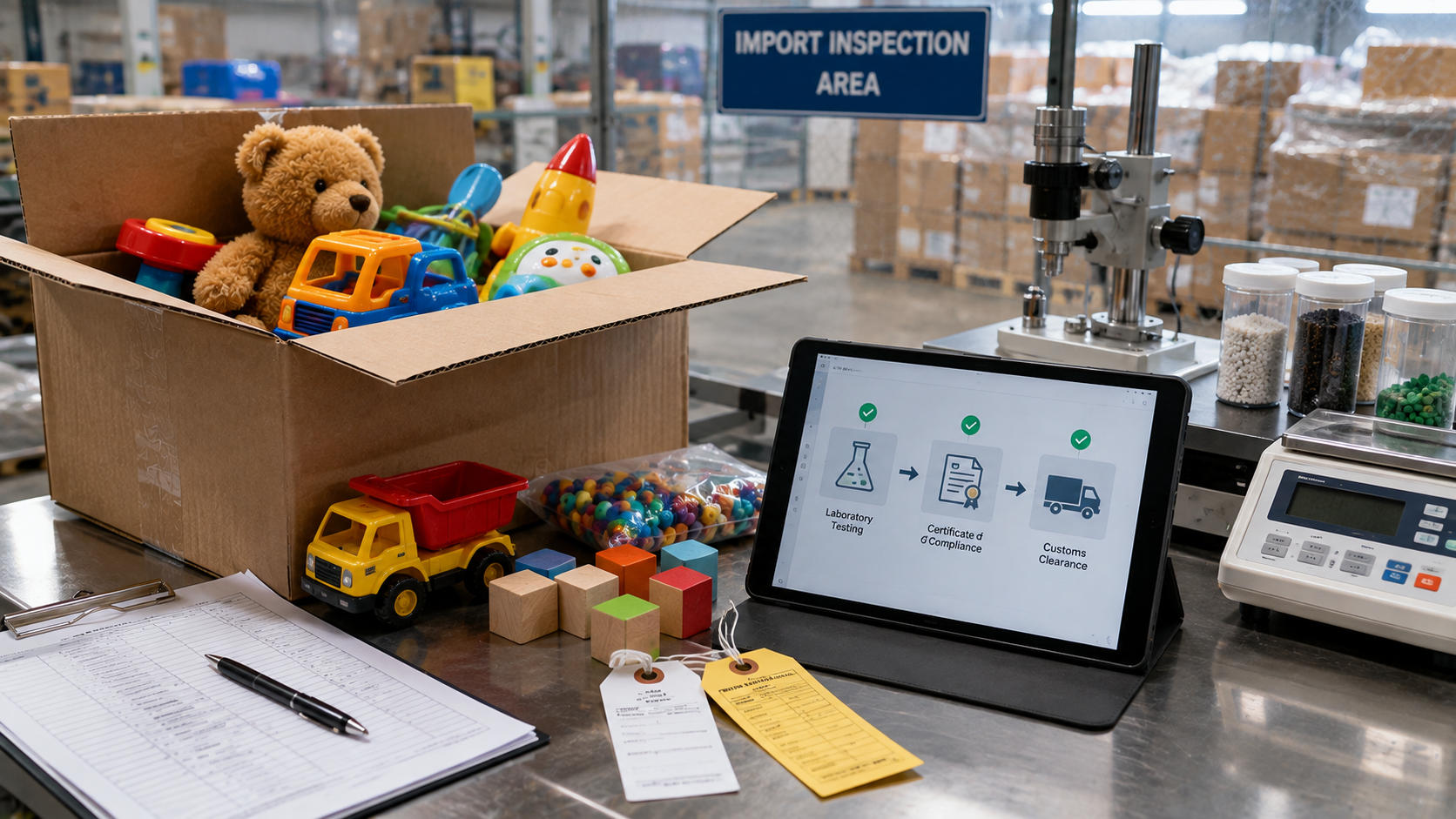
A major product-compliance change quietly became operational this summer.
Beginning July 8, 2026, importers of consumer products that require certification under U.S. Consumer Product Safety Commission rules must electronically submit certificate information when the products are imported into the United States.
The system is known as CPSC eFiling.
Instead of simply maintaining a paper or electronic compliance certificate and producing it when requested, covered importers now transmit certificate data electronically through U.S. Customs and Border Protection’s Automated Commercial Environment, or ACE. CPSC announced that mandatory eFiling officially went into effect on July 8, 2026.
For online sellers, private-label brands, importers, and resellers sourcing products overseas, the important question is not:
“Do I import products?”
It is:
“Do I import products that require a CPSC Certificate of Compliance?”
If the answer is yes, the new eFiling requirements may apply directly to your business.
What Changed on July 8, 2026?
CPSC already required certificates for many regulated consumer products before 2026.
The major change is how certificate information reaches the government.
Importers of covered products must now electronically file certificate data with CBP through a Partner Government Agency (PGA) Message Set when the customs entry is filed. CPSC says the program allows the agency to receive compliance information before regulated merchandise enters U.S. commerce.
The agency emphasizes that eFiling itself does not create entirely new testing or certification obligations. Importers were already responsible for creating and maintaining the underlying compliance information. The program changes how that data is submitted.
However, updated certificate-content requirements under revised 16 CFR Part 1110 also became applicable on July 8, so sellers should not assume that an old certificate template automatically satisfies the current requirements.
Does CPSC eFiling Apply to Every Imported Product?
No.
This is one of the most important distinctions.
CPSC states that eFiling applies to imported consumer products that are subject to a consumer product safety rule, ban, standard, or similar regulation enforced by the Commission and therefore require certification.
An imported product is not automatically subject to eFiling merely because it is sold to consumers.
Some products require CPSC certification.
Others do not.
Your first compliance task is therefore determining whether your specific product is subject to a CPSC rule requiring a certificate.
Two Major Types of Product Certificates
Most ecommerce sellers who encounter CPSC certification will deal with one of two certificate types.
Children’s Product Certificate — CPC
Children’s products designed or intended primarily for children 12 years old or younger that are subject to applicable children’s product safety rules generally require third-party testing by a CPSC-accepted laboratory and certification through a Children’s Product Certificate.
Depending on the product, applicable requirements may involve issues such as:
- lead
- phthalates
- small parts
- mechanical hazards
- flammability
- product-specific safety standards
- labeling or tracking requirements
The exact requirements depend on the product.
A children’s toy, infant product, or other children’s item should therefore never be evaluated simply by asking whether the supplier says it is “safe.”
You need to identify which actual U.S. safety rules apply.
General Certificate of Conformity — GCC
Certain regulated general-use products, meaning non-children’s consumer products, require a General Certificate of Conformity.
CPSC says manufacturers and importers of general-use products covered by applicable CPSC rules must certify compliance based on testing of the product or a reasonable testing program.
Examples of product categories subject to various CPSC rules include certain:
- bicycle products
- mattresses
- lighters
- household products
- recreational products
- clothing and textiles
- architectural components
- other specifically regulated consumer goods
The existence of a CPSC rule—not merely the general product category—determines whether certification is required.
Importing Does Not Automatically Mean You Need a CPC or GCC
Imagine two sellers importing merchandise.
Seller A imports a children’s product subject to multiple CPSC safety rules.
Seller B imports a general consumer product for which no CPSC rule requiring certification applies.
Seller A may need testing, a certificate, and eFiling.
Seller B may not.
That is why compliance research must happen at the SKU level, not simply at the shipment level.
CPSC maintains separate lists of rules requiring General Certificates of Conformity and rules requiring third-party testing and Children’s Product Certificates.
Who Is Responsible for eFiling?
For eFiling purposes, CPSC generally looks to the party responsible for the imported finished product.
The agency describes the importer as the Importer of Record eligible to make entry, which may be the owner, purchaser, or authorized customs broker.
However, if a customs broker is technically acting as Importer of Record but does not have sufficient knowledge of the product to accept testing and certification responsibility, the broker can identify the owner, purchaser, or consignee responsible for compliance.
For many small ecommerce businesses, this means the customs broker may submit the electronic data, while the seller remains responsible for ensuring that the product and certificate information are correct.
Do not confuse:
Who files the customs message
with
Who is responsible for product compliance.
They may not be the same party.
Your Supplier Is Not Automatically Responsible
Suppose you manufacture a private-label product overseas.
The factory gives you:
- a laboratory report
- a product specification sheet
- manufacturing records
- test results
Those documents may help support certification.
But they do not necessarily transfer the U.S. importer’s legal responsibility to the foreign factory.
For regulated general-use products manufactured overseas, CPSC guidance states that the U.S. importer is responsible for issuing the GCC.
Children’s products likewise require the appropriate finished-product certification supported by qualifying testing.
A supplier’s statement saying:
“CPSC approved”
is not a substitute for determining which rules apply and whether your certification documentation is valid.
What Information Does an eFiled Certificate Contain?
CPSC’s eFiling requirements involve detailed information that allows regulators to connect the imported product with its manufacturing and testing history.
Required certificate information can include:
- identification of the finished product
- applicable CPSC safety rules
- the party certifying compliance
- manufacturing date
- manufacturing location
- testing date
- testing location or laboratory
- contact information for the party maintaining test records
CPSC highlighted these data categories when announcing the final rule.
If your supplier cannot provide basic manufacturing and testing details before shipping, that should be treated as a compliance warning.
Product Identification Matters More Than Ever
A certificate needs to match the actual imported product.
CPSC currently allows several types of Product IDs in its eFiling system, including:
- GTIN
- SKU
- UPC
- model number
- serial number
- registered number
- alternate product ID
CPSC strongly recommends using at least one identifier that also appears on the product, packaging, packing list, or invoice so enforcement personnel can connect the certificate with the physical merchandise.
This has an important operational consequence for ecommerce sellers.
Your:
product catalog
supplier documentation
commercial invoice
customs entry
testing records
and
certificate
should identify the product consistently.
If your internal SKU says:
KB-104-BLK
while the test report references:
Model KitchenBottle-2024
and the commercial invoice says simply:
water bottles
you may create unnecessary ambiguity.
There Are Two Main Ways to eFile
Importers generally have two practical filing approaches.
Option 1: Reference PGA Message Set
The importer first stores the complete certificate information in the CPSC Product Registry.
At customs entry, the filer then submits a short reference identifying the certificate using information including:
Certifier ID
Product ID
Version ID
The government can use those identifiers to locate the corresponding certificate information.
This approach can be useful for sellers importing the same products repeatedly.
Instead of transmitting the entire certificate dataset every time, the entry can reference certificate information already stored in the registry.
Option 2: Full PGA Message Set
The second approach is to send all required certificate information directly as part of the customs entry.
CPSC describes the Full PGA Message Set as the method used when the filer is not referencing a certificate already stored in the Product Registry.
Which method makes sense depends on:
- shipment volume
- number of SKUs
- frequency of repeat imports
- customs broker capabilities
- internal systems
- how frequently certificate information changes
A seller importing the same 20 SKUs every month may benefit more from maintaining certificates in the registry than a business making an occasional one-time import.
Important: The CPSC Product Registry Does Not File Your Customs Entry
This is an easy misunderstanding.
Uploading product certificate information to the CPSC Product Registry does not by itself transmit the customs entry to CBP.
CPSC explains that its Product Registry is a secure central repository for certificate data but does not directly communicate with CBP’s ACE system.
Your broker or other filer still needs to send the appropriate PGA Message Set through ACE when the entry is made.
Think of the Reference method as two connected steps:
Step 1: Store the certificate.
Step 2: Reference that certificate during customs filing.
Completing Step 1 does not eliminate Step 2.
One Product Can Mean One eFiling Submission
Sellers with large catalogs should pay attention to product-level organization.
CPSC’s current eFiling procedures require individual product submissions rather than treating an entire container of mixed inventory as one generic product certificate.
CPSC’s CPC guidance specifically notes that while certificates historically can cover multiple similar products in some circumstances, under the eFiling procedures each product needs its own separate submission.
Imagine an importer brings in:
10 toy models
5 colors of children’s backpacks
8 models of another regulated product
The compliance workload may need to be organized around individual finished products rather than simply:
Shipment #1842
That makes clean SKU management increasingly important.
Testing Data Must Support the Finished Product Certificate
Another potential trap involves component testing.
Suppose a children’s product contains:
painted metal parts
plastic pieces
textile components
buttons
printed packaging
Your final certificate might rely on multiple tests performed on different components.
CPSC’s current FAQ says that when component test results are relied upon to certify the finished product, the relevant testing information must be reflected in the certificate. The certificate must associate testing entities with the applicable rules they tested.
CPSC also says revised Part 1110 now requires applicable testing exclusions to be identified beginning July 8, 2026.
This makes supplier-document management much more important than simply keeping one PDF marked:
TEST REPORT
What If Your Product Does Not Require a Certificate?
If a product is not subject to a CPSC rule requiring certification, then the mandatory certificate eFiling requirement does not apply.
However, certain HTS classifications may still trigger CPSC-related customs screening.
CPSC provides an optional Disclaimer PGA Message Set that can tell the agency that the particular product does not require a certificate.
CPSC currently says disclaimer filings are not mandatory, though the agency encourages importers to use them because doing so may improve import risk assessment.
Examples can include products where:
- CPSC has jurisdiction but no certification rule applies
- the product is outside CPSC jurisdiction
- only a component rather than a finished regulated product is being imported
- qualifying enforcement discretion applies
Your broker should use the correct disclaimer rather than simply assuming that no CPSC data means nothing needs to be communicated.
Practical Example: Private-Label Children’s Toy
Suppose you sell a private-label children’s toy manufactured overseas.
Your process should begin before placing the production order.
First, determine every applicable children’s product safety rule.
Then arrange required third-party testing through a CPSC-accepted laboratory.
After successful testing, prepare the Children’s Product Certificate containing the required product, manufacturing, testing, and certifier information.
Before importing, organize the certificate information for eFiling.
If you use the Product Registry, your broker can submit the applicable Reference PGA Message Set during customs entry.
The product should not arrive at the border while you are still asking the factory:
“Do you have the test report?”
By that point, the compliance process should already be complete.
Practical Example: Regulated General-Use Product
Now imagine an ecommerce company imports a general-use product subject to a CPSC rule requiring a GCC.
The importer determines the applicable regulation.
Testing or a reasonable testing program supports compliance.
The importer prepares the GCC.
The certificate information is either:
stored in the Product Registry and referenced at customs entry,
or
submitted through a Full PGA Message Set.
The system differs from children’s products because children’s products often involve mandatory CPSC-accepted third-party laboratory testing, while general-use certification can operate under different testing requirements depending on the rule.
Practical Example: Domestic Reseller Buying From a U.S. Distributor
Suppose you operate an online resale business but purchase all inventory from established U.S. distributors.
You are not importing the merchandise yourself.
In that situation, the new importer eFiling requirement generally is not your customs-filing responsibility.
That does not mean product compliance is irrelevant.
Marketplaces may request:
- CPCs
- GCCs
- laboratory reports
- product-safety documentation
- invoices identifying your supplier
For regulated products, make compliance-document availability part of your supplier-selection process.
A domestic distributor saying:
“We already imported it”
is useful.
A distributor saying:
“We have no idea whether any safety documentation exists”
is very different.
Cross-Border Marketplace Orders Can Still Be Commercial Transactions
Small sellers should also be careful with individual packages shipped directly from overseas.
CPSC’s current FAQ states that commercial sales between consumers—including sales conducted through online marketplaces or other selling platforms—are not treated as noncommercial gifts merely because one individual is shipping to another.
In other words:
Small package ≠ personal transaction.
If a regulated product is being commercially imported, its compliance obligations should be evaluated as a commercial import.
Common Mistakes Online Sellers Should Avoid
Mistake 1: Assuming eFiling Applies to Everything
It applies to products requiring CPSC certification, not every imported object.
Determine the applicable safety rules first.
Mistake 2: Waiting Until the Shipment Arrives
Testing, certification, and data preparation should happen before customs entry.
Trying to reconstruct manufacturing and laboratory information while inventory is already at the border creates avoidable risk.
Mistake 3: Assuming the Customs Broker Handles Product Compliance
The broker may transmit information.
That does not mean the broker has independently determined that your children’s toy meets every applicable U.S. safety standard.
Mistake 4: Treating the Supplier’s Test Report as the Certificate
A laboratory report supports certification.
It is not automatically the same thing as a CPC or GCC.
Mistake 5: Using Generic Product Descriptions
Certificates should clearly identify the finished product.
Build consistency between SKU, invoice, certificate, product packaging, and test records.
Mistake 6: Forgetting Product Changes
Changing:
materials
paint
components
supplier
manufacturing location
construction
or other product characteristics
may affect the validity of existing testing or certification.
Do not automatically assume last year’s certificate covers this year’s revised product.
Mistake 7: Assuming Product Registry Means Customs Filing Is Finished
It does not.
A corresponding PGA filing still needs to occur through ACE.
Build a Product Compliance File for Every Regulated SKU
A simple compliance folder can save significant time.
For each regulated SKU, consider maintaining:
| Record | Keep Available |
|---|---|
| Product name | Exact finished-product identification |
| Internal SKU | Current product identifier |
| UPC / GTIN / model | If applicable |
| Product specifications | Current version |
| Applicable CPSC rules | Complete citation list |
| Test reports | Current supporting reports |
| Testing laboratory | Contact and location information |
| Manufacturing facility | Name, address, contact |
| Manufacturing date / batch | As applicable |
| CPC or GCC | Current certificate |
| Product Registry ID | If using reference filing |
| Version ID | Current certificate version |
| Customs broker instructions | Current filing procedure |
| Supplier documentation | Purchase and production records |
The objective is simple:
If your broker asks for compliance information shortly before entry, you should not need to email your overseas supplier and wait three days for an answer.
Add Compliance Review to Product Sourcing
Product research should no longer stop at:
Purchase price
Selling price
Marketplace fees
Shipping
Tariffs
For regulated products, sourcing should also include:
Applicable product-safety rules
Testing cost
Certification requirements
Labeling requirements
eFiling requirements
Documentation availability
A product with an excellent theoretical margin can become a poor sourcing choice if compliant testing, documentation, and quality control are difficult to maintain.
This is particularly important when sourcing children’s products.
A slightly cheaper factory with weak testing documentation may ultimately be far more expensive than a supplier with an established compliance process.
Ask Overseas Suppliers Better Questions
Instead of asking:
“Is this CPSC compliant?”
ask:
Which U.S. CPSC regulations has this exact model been tested against?
Which laboratory performed the tests?
Is the laboratory CPSC-accepted where required?
What exact model or SKU appears on the report?
What manufacturing facility produced the tested product?
When was it tested?
Have any materials, components, factories, or designs changed since testing?
Can you provide the complete reports before I order?
Those questions produce much more useful information than receiving a one-word:
Yes.
The Foreign Trade Zone Deadline Is Different
One group still has additional implementation time.
For qualifying CPSC-regulated merchandise imported into a Foreign Trade Zone and later entered for consumption or warehousing, the revised eFiling requirements become applicable on January 8, 2027 rather than July 8, 2026.
Ordinary ecommerce imports should not assume this extension applies simply because goods temporarily sit in a warehouse.
Foreign Trade Zones have specific customs status.
A Practical 2026 eFiling Checklist
Before importing a new consumer product, verify:
- Is the merchandise within CPSC jurisdiction?
- Does a CPSC rule, ban, standard, or regulation apply?
- Does that rule require a certificate?
- Is the product a children’s product or general-use product?
- What testing is required?
- Has the exact finished product been properly tested?
- Do you have all supporting test reports?
- Do you have the correct CPC or GCC?
- Does the certificate clearly identify the finished product?
- Do product identifiers match invoices and customs documents?
- Do you have manufacturing dates and facility information?
- Do you have the required laboratory information?
- Who will be the compliance certifier?
- Who will file the customs entry?
- Will you use a Full or Reference PGA Message Set?
- If using the Product Registry, has the certificate been created and updated?
- Does your customs broker have the correct Certifier ID, Product ID, and Version ID?
- If no certificate is required, should a Disclaimer PGA Message Set be used?
- Have you reviewed the process before the shipment leaves the supplier?
Final Takeaway
CPSC eFiling represents a significant change in how imported regulated consumer products move through U.S. customs.
As of July 8, 2026, covered importers can no longer treat the Certificate of Compliance as something that simply sits in a folder until someone asks for it.
Certificate information has become part of the electronic import process.
For online sellers, the safest workflow is:
Identify the regulation before buying.
Test before shipping.
Certify before importing.
Organize product data before customs entry.
Coordinate with the broker before inventory reaches the border.
The new system does not make every imported product regulated.
But for products that already require CPSC certification, compliance documentation now needs to be much more tightly integrated with sourcing, inventory, and customs operations.
That makes product compliance not just a legal issue.
It is now part of ecommerce logistics.
Sources
U.S. Consumer Product Safety Commission — Mandatory eFiling Implementation, July 8, 2026. CPSC announced that electronic certificate filing is now in effect for regulated imported consumer products.
CPSC mandatory eFiling announcement
U.S. Consumer Product Safety Commission — Certificates of Compliance and eFiling. Current guidance covering July 8, 2026 applicability and the January 8, 2027 Foreign Trade Zone date.
CPSC Certificates of Compliance guidance
U.S. Consumer Product Safety Commission — eFiling FAQ. Covers product IDs, testing information, commercial transactions, disclaimers, and Product Registry procedures.
CPSC eFiling FAQ
U.S. Consumer Product Safety Commission — Resources for Importers. Explains importer responsibilities and the relationship among owners, purchasers, consignees, importers of record, and customs brokers.
CPSC eFiling resources for importers
U.S. Consumer Product Safety Commission — CPSC Product Registry. Explains how importers can store certificate data for Reference PGA Message Set filings.
CPSC Product Registry information
Recent Comments